


Wilderness survival demands an edged tool capable of processing kindling, notching shelter poles, and skinning game without edge deformation or catastrophic failure. When outdoor enthusiasts debate what is the best survival knife on the market, the answer rarely hinges on flashy tactical aesthetics. Instead, functional reliability rests on predictable blade steels, resilient tang geometry, and ergonomic handle traction during freezing or rain-soaked field tasks. A dependable outdoor blade must absorb mechanical shock while holding a serviceable working apex through prolonged utility cutting.
Many field practitioners start by comparing compact five-inch fixed blade knife options with hefty camp bowies to identify their specific balance between chopping authority and carving finesse. Premium tool steels like D2 deliver extended edge retention, while dependable stainless alloys such as 440C provide enhanced rust resistance across damp environments. Structural integrity often separates dependable survival gear from decorative novelties that loosen under rigorous use. Understanding how full-tang construction, blade grind profiles, and secure sheath retention interact ensures you carry a dependable cutting tool when standard gear fails.

Pros
- Full tang design provides superior durability and balance for demanding tasks.
- Razor-sharp stainless steel blade with saw back enhances cutting versatility.
- Comfortable, non-slip rubber handle ensures secure control in all conditions.
- Comes with essential accessories: sheath, sharpener, and fire starter.
- Lightweight at 1.05 pounds, making it easy to carry on outdoor adventures.
Cons
- Stainless steel blade may not retain its edge as long as high-carbon steel options.
- Saw back teeth could dull quickly when used on hard or abrasive materials.
- Included fire starter is a basic ferro rod that requires practice to ignite effectively.
The FLISSA Survival Hunting Knife is a 15-inch full tang fixed blade tactical bowie knife designed for outdoor enthusiasts who need a reliable, multi-functional tool. With an overall length of 15 inches and a 10-inch blade, this knife is built to handle heavy-duty cutting, chopping, and even light prying. It comes complete with a sheath, a sharpener, and a fire starter, making it a ready-to-use survival kit for campers, hunters, and bushcraft practitioners.
Standout features include a razor-sharp clip point blade made from stainless steel, which offers good hardness and rust resistance. The blade also has a saw back for added utility when cutting through wood or rope. The full tang construction means the blade extends through the handle, providing strength and stability for demanding tasks. In real-world use, this knife performs well for batoning wood, preparing tinder, and general camp chores, though the saw back is more suited for light sawing than heavy timber work.
Design and build quality are solid for the price point. The rubber handle offers a comfortable, non-slip grip even when wet, and the included heavy-duty sheath features a secure fastening system and a belt loop for convenient carry. At 1.05 pounds, the knife is lightweight enough to pack without adding excessive weight, while still feeling substantial in hand. The sharpener and fire starter are practical additions that enhance the knife's value for outdoor survival scenarios.
However, there are some drawbacks to consider. The stainless steel, while corrosion-resistant, may not hold an edge as long as high-carbon alternatives, requiring more frequent sharpening. The saw back teeth could also lose effectiveness if used aggressively on hard materials. Additionally, the fire starter is a basic ferro rod that requires some skill to use, so beginners may need practice. These limitations are typical for budget-oriented survival tools but are worth noting.
Overall, the FLISSA Survival Hunting Knife offers excellent value for its price. It provides the essential features needed for camping, hunting, and survival tasks in a durable, user-friendly package. While not a premium blade, it is a dependable choice for outdoor enthusiasts seeking an affordable, all-in-one tool that performs reliably in the field.
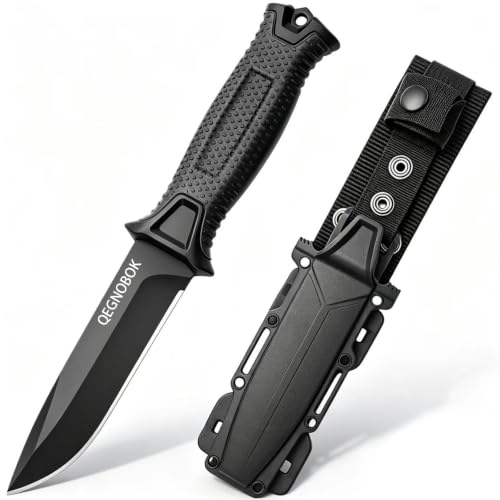
Pros
- Indestructible 5mm full-tang spine withstands heavy butchery and rough camp prep
- Textured ABS grip stays secure even when processing wet meats or greasy foods
- Custom Kydex sheath keeps the blade safely locked during travel and storage
- Low-maintenance stainless steel cleans up easily after camp meal prep
Cons
- Thick blade spine wedges and cracks dense produce like carrots and potatoes instead of slicing cleanly
- Heavy, bulky profile makes fine kitchen work like mincing herbs or dicing garlic impractical
- Bevel geometry is tuned for impact resistance rather than delicate culinary slicing
While originally designed for tactical and field use, the QEGNOBOK 4.8-inch fixed blade knife fills a specific niche for outdoor cooking, chuck box meal prep, and camp butchery. It is built for campfire cooks, hunters, and budget-conscious outdoor enthusiasts who need a tough utility tool that can handle rough prep work without fear of chipping a delicate chef knife.
The defining feature here is the 5mm thick full-tang stainless steel spine. In an outdoor kitchen setting, this heavy-duty backbone gives you the leverage to press through tough poultry joints, strip ribs, and trim game. Out of the box, the edge comes sharp enough for general food tasks, though its wider bevel profile emphasizes edge stability over laser-thin precision. The textured ABS handle provides a firm, locked-in grip that prevents slippage when dealing with animal fats, marinades, or wet kitchen conditions.
Naturally, this knife has clear limitations on an indoor cutting board. Because the blade is so thick, it tends to wedge and split hard root vegetables like carrots, squash, or large onions rather than gliding through them. It lacks the tall blade height and thin profile needed for effortless vegetable chopping or fine kitchen prep. You will not want to use it for dicing shallots or creating paper-thin tomato slices.
For camp cooks needing a dependable workhorse that bridges the gap between field chores and heavy-duty cooking prep, this knife makes a practical companion. It takes heavy punishment, shrugs off moisture, and stores securely in its fitted Kydex sheath. It represents a practical, affordable choice for anyone who wants an indestructible knife for rugged outdoor meals.
This knife shines brightest in outdoor and mobile cooking scenarios where traditional kitchen cutlery is too fragile to survive. It is particularly well suited for breaking down whole chickens, cracking joints, portioning racks of ribs, and skinning or trimming wild game around the campfire.
It also serves as an all-around camp kitchen backup tool. When you are not slicing meat, you can use the thick spine to baton kindling for the cooking fire, carve roasting sticks, or open heavy food packaging without dulling your primary chef knife.
Because the blade is crafted from stainless steel, routine maintenance is straightforward. Wash the blade with mild dish soap and warm water after processing meats or acidic foods, then dry it completely before inserting it into the Kydex sheath to prevent moisture buildup.
To maintain its cutting edge, hone the blade periodically using a standard sharpening stone or pull-through outdoor sharpener. Avoid cleaning this knife in an automatic dishwasher, as harsh detergent cycles can degrade the handle hardware over time.
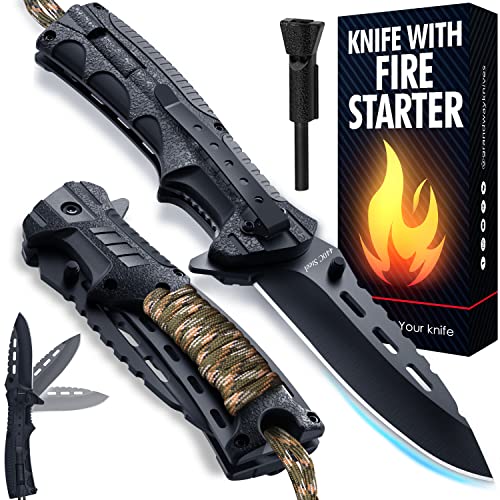
Pros
- Sharp 3.74-inch blade made from high-quality 440C stainless steel with 60 HRC hardness
- Integrated fire starter and whistle add essential survival functionality
- Paracord handle enhances grip and provides emergency cordage
- Liner lock mechanism ensures safe blade retention during use
- Affordable price point for a multifunctional outdoor tool
Cons
- Plastic handle may feel less premium compared to full-metal designs
- Lightweight construction might not withstand heavy-duty or abusive use
- Limited to basic survival tasks; not ideal for heavy chopping or batoning
The Grand Way Pocket Knife (model 6772) is a budget-friendly survival tool designed for outdoor enthusiasts who need a compact, multifunctional blade. With a 3.74-inch 440C stainless steel blade hardened to 60 HRC, this folding knife offers reliable sharpness for everyday cutting tasks. The inclusion of a fire starter rod and whistle transforms it into a practical survival kit, making it suitable for camping, hiking, hunting, and emergency situations.
In real-world use, the knife deploys smoothly with one hand thanks to its thumb stud and liner lock mechanism. The blade locks securely in place, providing confidence during use. The paracord-wrapped handle not only offers a comfortable and secure grip but also serves as an emergency cordage source. The pocket clip allows for convenient and discreet carry, ensuring the tool is always within reach.
The build quality is decent for the price, featuring a durable plastic handle that keeps weight low (4.23 oz). While the plastic construction may not feel as robust as metal handles, it contributes to the knife's lightweight and portable nature. The fire starter and whistle are functional additions, though they are basic and may require practice to use effectively in adverse conditions.
Potential drawbacks include the plastic handle's limited durability under extreme stress and the knife's overall lightweight design, which may not be suited for heavy-duty tasks like batoning wood. However, for its intended purpose as a compact survival companion and EDC tool, these limitations are acceptable given the affordable price.
Overall, the Grand Way Pocket Knife offers excellent value for outdoor enthusiasts seeking an affordable, multifunctional tool. It makes a thoughtful gift for dads, husbands, boyfriends, or anyone who enjoys outdoor adventures. While not a premium knife, it delivers reliable performance for basic survival and everyday carry needs.

Pros
- Heavy-duty 5mm full tang spine handles rigorous chopping and outdoor meat prep without flexing
- D2 tool steel maintains a sharp working edge much longer than standard entry-level stainless cutlery
- Custom Kydex sheath locks the knife securely in place for travel and field kitchen use
- Deep handle contours and textured grip offer dependable hold during messy butchering tasks
Cons
- Semi-stainless D2 steel demands immediate hand drying and occasional oiling to prevent surface patina and rust
- Thick 5mm blade geometry causes wedging on firm vegetables like raw potatoes or carrots instead of clean slicing
- Heavy overall weight is not well-suited for extended, fine indoor vegetable dicing
The Freelander Outdoor Fixed Blade Knife sits at the intersection of a heavy-duty field tool and a rugged camp kitchen workhorse. Unlike thin, flexible culinary knives found in typical residential knife blocks, this is a heavy-duty fixed blade built around a beefy 5mm full-tang spine. It is specifically suited for camp cooks, backcountry hunters, barbecue pitmasters, and outdoor hobbyists who need a knife tough enough to process dense proteins, split kindling for a cooking fire, and tackle rough field prep where standard chef knives would chip or snap.
In terms of performance, the knife arrives with a clean, functional edge out of the box. The D2 tool steel blade offers noticeable wear resistance, meaning you can carve through dense fibrous meat, joints, and tough packaging without constantly reaching for a honing rod. The balance is blade-forward due to the sheer thickness of the spine, giving your cuts natural downward momentum when separating poultry joints or carving hardwood skewers around the campfire.
Build quality stands out as a strong point given the single piece of steel running from tip to pommel. The contoured grip incorporates molded finger grooves and surface texturing that give your hand plenty of traction, which is a major safety advantage when working with raw meats, marinade oils, or cold outdoor moisture. The accompanying Kydex sheath fits the blade tightly, snapping securely around the guard so you can attach it to a gear bag or belt without worrying about accidental slips.
The obvious limitation is its blade geometry. Because the spine measures a full 5mm thick, this knife is not engineered for paper-thin tomato slices or delicate herb chiffonades. When pushed through firm produce like large carrots or onions, it tends to split rather than slice. Furthermore, because D2 steel is semi-stainless rather than fully stainless, running it through a dishwasher or leaving it wet in a camp sink will lead to surface oxidation.
If you need a delicate indoor slicing knife, stick to a standard chef knife or santoku. However, if you want a nearly indestructible utility blade to throw into your camp kitchen bin, tackle rough outdoor butchery, and handle demanding camp chores without fear of damaging the edge, the Freelander fixed blade provides exceptional durability and dependable cutting power.
D2 tool steel contains roughly 12 percent chromium, making it technically semi-stainless. While it provides far better stain resistance than pure carbon steel, it will still develop a patina or surface rust if neglected. Always hand wash the blade with warm water and mild soap after meal prep, avoiding abrasive scouring pads that could scratch the finish.
Dry the knife thoroughly with a clean cloth immediately after washing. Before sheathing the blade for storage, apply a light coat of food-safe mineral oil or camellia oil across the steel surface. Keep the Kydex sheath clean and free of trapped grit or trapped moisture to prevent scratching the blade finish or encouraging rust spots during off-season storage.
This knife is tailored for rugged food prep and utility situations where ordinary kitchen cutlery is too fragile. It works exceptionally well for camp cookery, cutting up thick cuts of beef, breaking down wild game, trimming brisket fat, and slicing dense smoked meats outdoors.
Outside of direct food contact, its heavy 5mm full-tang spine makes it an excellent survival companion for making kindling, shaving feather sticks to start camp cooking fires, cutting heavy cordage, and opening vacuum-sealed meal packs.

Pros
- Sharp 440C steel blade offers good edge retention and corrosion resistance
- Lightweight at 6.4 ounces reduces carry burden on long treks
- Anti-slip handle design improves safety during wet or heavy use
- Nylon sheath protects blade and allows easy belt attachment
- Versatile enough for multiple outdoor activities from camping to farming
Cons
- ABS plastic handle may feel less premium than full tang or wood options
- Blade thickness of 2.5mm is thinner than some heavy-duty survival knives
- No visible reviews yet to confirm real-world performance
The DOOM BLADE 11.1-inch fixed blade knife is a budget-friendly survival tool designed for outdoor enthusiasts who need a reliable blade without breaking the bank. Featuring a 440C stainless steel blade and an ABS plastic handle, this bowie-style knife targets campers, hikers, hunters, and bushcrafters looking for a lightweight companion for cutting, chopping, and general outdoor tasks.
At its core, the knife boasts a 6.2-inch blade made from 440C steel, known for its good wear resistance, toughness, and rust resistance. The blade measures 1.26 inches wide and 2.5mm thick, offering a balance between slicing efficiency and moderate durability. The handle is wrapped in ABS plastic with engraved anti-slip lines, ensuring a comfortable and secure grip even in wet or sweaty conditions. Weighing only 6.4 ounces, it minimizes fatigue during extended use and packs easily into a backpack or on a belt via the included nylon sheath.
In terms of design, the knife has a total length of 11.1 inches, providing ample leverage for tasks like splitting small wood or cutting rope. The handle length of 4.9 inches fits most hand sizes comfortably, though users with larger hands may find it slightly short. The nylon sheath is functional for storage and carry but lacks a belt loop or retention strap, which some users might prefer for secure carry during active movement.
Potential drawbacks include the ABS handle, which may not appeal to those who prefer full tang or natural materials, and the 2.5mm blade thickness, which is thinner than some heavy-duty survival knives and may not withstand extreme prying or batoning. Additionally, the product has no customer reviews yet, so real-world performance is unverified. However, DOOM BLADE promises 24-hour customer service support for any issues.
Overall, the DOOM BLADE fixed blade knife is a solid entry-level option for beginners or as a backup tool for experienced outdoorsmen. Its lightweight build, sharp 440C steel, and affordable price make it suitable for camping, fishing, hiking, and farm work. If you need a heavy-duty chopper or a premium handle, consider higher-end models, but for basic outdoor tasks, this knife delivers value.

Pros
- 3Cr13 stainless steel provides excellent rust resistance during outdoor prep near water
- Drop point blade shape offers good control for general slicing and trimming
- Included nylon sheath protects the edge during transport in camp gear boxes
- Easy to touch up in the field with basic pocket sharpeners
Cons
- Hollow metal handle lacks the ergonomic grip and food-safe hygiene of traditional kitchen cutlery
- Low edge retention requires regular honing during extended cutting sessions
- Lacks full-tang strength, making it unsuited for heavy chopping or splitting tasks
The SURVIVOR HK-695 occupies a unique niche between a traditional camp knife and an outdoor utility prep blade. Built with a 5.00-inch drop-point blade and a 4.00-inch textured metal handle, this fixed-blade tool is designed for outdoor cooking, general camp tasks, and emergency field utility where delicate culinary knives simply should not go.
This knife is best suited for budget-conscious campers, hunters, and outdoor cooks who need an inexpensive workhorse for their chuck box or tackle bag. If you need a blade to slice cured meats around a fire pit, trim fat off game meat, or slice open heavy packaging without worrying about ruining a high-end chef knife, this tool fills that role easily.
Out of the box, the fine edge offers adequate sharpness for everyday cutting chores. The blade geometry features a gradual drop point with enough belly to make smooth cuts through sausages, potatoes, and campfire vegetables. Edge retention is relatively modest because of the softer 3Cr13 steel composition, but the upside is that it sharpens back to a keen edge with minimal effort on any pocket whetstone or pull-through ceramic rod.
Build quality reflects its budget utility roots. The satin-finished 3Cr13 stainless steel holds up well against moisture, rust, and food acids, which is a major plus around humid campsites. The handle is hollow cast metal containing a small survival kit and compass beneath a threaded end cap. Because it is hollow, this knife does not have a full tang. You should avoid batoning firewood or prying with it, and the textured metal handle can feel slick when handling greasy meats or wet fish.
For home cooks seeking refined slicing performance on an indoor cutting board, a standard Santoku or chef knife is a much better choice. However, for backcountry travelers and outdoor cooks needing a tough, weather-resistant utility blade that can handle campfire prep and general trail duty, the HK-695 serves as an affordable field companion.
Wash the knife by hand using mild soap and warm water immediately after food preparation. Never run this knife through an automatic dishwasher, as harsh detergents and high heat can degrade the handle finish and sheath components.
Because the handle is hollow and features threaded components, keep grease and meat juices away from the butt cap seam. Dry the entire knife thoroughly before returning it to the nylon sheath to prevent moisture from trapping against the steel.
Maintain the 3Cr13 stainless steel cutting edge with regular passes on a fine ceramic rod or pocket whetstone. The steel responds quickly to basic maintenance, making it easy to restore a working edge in minutes.
Campfire Cooking: Slicing meats, prepping vegetables on a camp cutting board, and cutting through tough packaging at an outdoor cooking station.
Tackle Box Utility: Cleaning small panfish, trimming monofilament line, and handling basic shoreline chores where moisture resistance matters.
Chuck Box Backup: Keeping a designated rough-use blade in your camp kitchen kit to spare your good kitchen knives from being damaged on hard surfaces or outdoor debris.

Pros
- Exceptional noise cancellation that rivals top competitors
- Rich, detailed sound quality with customizable EQ
- Comfortable fit for hours of listening without fatigue
- Long battery life with fast charging capability
- Seamless Bluetooth pairing and multipoint connection
Cons
- Carrying case is larger than previous models, slightly bulky
- Touch controls can be overly sensitive in some conditions
- No included USB-C wall charger in the box
The Sony WH-1000XM5 wireless noise-cancelling headphones are designed for audiophiles and frequent travelers who demand the best in sound isolation and audio quality. These over-ear headphones are perfect for anyone seeking a premium listening experience in noisy environments, from busy offices to crowded planes.
Standout features include Sony's adaptive sound control, which automatically adjusts noise cancellation based on your activity and location, ensuring optimal immersion without missing important sounds. The 30mm drivers deliver crystal clear audio with rich bass and crisp highs, while support for LDAC and DSEE Extreme enhances streaming quality. Real-world performance is stellar, with effective noise cancellation that blocks out low-frequency hums and chatter, and a battery that easily lasts through long flights.
The design is sleek and modern, with a lightweight build and plush synthetic leather ear cups that provide comfort during extended use. The folding mechanism and included carrying case make it portable, though the case is slightly larger than the previous generation. Controls are intuitive via touch gestures and voice assistant integration, but the touch panel can occasionally register accidental inputs when adjusting the headphones.
Potential drawbacks include the lack of a dedicated power button (it uses a power on/off by folding/unfolding), and the absence of a USB-C wall charger in the box. Some users may also find the noise cancellation too aggressive for quiet environments, but this can be adjusted via the app.
Overall, the Sony WH-1000XM5 is a top contender in the premium noise-cancelling headphone market, offering exceptional sound, comfort, and battery life. It's a worthy investment for those who prioritize audio quality and noise isolation for travel or daily commutes.
Evaluating Survival Knives: Structural Integrity, Steel Performance, and Field Utility
Determining what constitutes the best survival knife on the market requires looking beyond dramatic marketing labels and examining raw mechanical capabilities. A true survival blade functions as an emergency lifeline designed to split kindling, construct emergency shelters, prepare wild game, and strike ferrocerium fire rods. Because outdoor emergencies present unpredictable demands, the optimal knife must balance structural toughness with efficient slicing geometry. Compromising on critical build elements like tang architecture or steel composition can leave an adventurer stranded with a broken tool far from civilization.
Practical survival scenarios rarely involve hand-to-hand combat or dramatic Hollywood encounters. Rather, real wilderness survival involves mundane, calorie-intensive chores like batoning hardwood, fabricating tent stakes, carving feather sticks, and opening canned rations. Each of these tasks places distinct stresses on the blade apex, spine, and handle junction. By analyzing blade geometry, metallurgical properties, and retention systems, outdoor practitioners can select a blade tailored to their specific environment and survival philosophy.
Full Tang Versus Hollow Handle Architecture
Tang architecture forms the structural backbone of any dependable fixed-blade survival knife. A full-tang construction features a solid piece of steel running continuously from the tip of the blade to the base of the pommel, sandwiched between handle scales. Models engineered with a 5mm thick full-tang spine, such as those found on heavy-duty bushcraft blades like the Freelander or QEGNOBOK tactical knives, offer exceptional impact resistance during batoning. When an adventurer strikes the spine with a wooden baton to split firewood, a full tang distributes force evenly without creating weak stress risers.
Hollow-handle survival knives, exemplified by classic survival designs like the SURVIVOR fixed blade series, present a fundamentally different engineering philosophy. These designs feature a hollow metal cylinder inside the grip to store emergency equipment such as matches, fishing hooks, and a compass. While self-contained survival kits provide convenience, the joint where the blade connects to the hollow handle introduces a distinct mechanical weak point. Under heavy lateral prying or intense batoning against dense knots, partial-tang and hollow-handle connections face elevated risks of shearing or loosening.
Folding knives, such as the Grand Way pocket knife with a liner lock, serve an entirely different functional tier within an emergency gear kit. A folding knife introduces pivot screws, locking bars, and moving components that can collect grit or fail under heavy transverse loads. Survival practitioners universally favor stout fixed blades as their primary wilderness workhorses due to their lack of moving parts. However, a lightweight folding blade featuring a 3.74-inch stainless edge and an integrated whistle makes an outstanding secondary backup kept secure in a pocket.
Blade Metallurgy: Edge Retention Versus Field Sharpenability
Blade steel composition dictates how long a cutting edge lasts, how easily it sharpens in the woods, and how well it resists environmental oxidation. Modern outdoor knives frequently employ high-performance D2 tool steel, known for its outstanding wear resistance and edge holding capabilities. Heat-treated up to 60 HRC, D2 steel features large chromium carbides that allow a knife to carve hardwood stakes for hours without rolling its apex. The tradeoff emerges when the blade eventually dulls, as highly wear-resistant steels demand diamond abrasives or ceramic stones rather than standard river rocks to restore a working edge.
Traditional stainless alloys like 440C stainless steel provide an excellent middle ground for humid or maritime survival environments. Featured prominently on blades from Grand Way and DOOM BLADE, 440C offers high chromium content that naturally shields the steel against rust and pitting without demanding constant oiling. While 440C possesses slightly lower edge retention than specialized semi-stainless tool steels, its microstructural toughness resists micro-chipping when impacting dense bone or frozen wood. Furthermore, an adventurer can quickly re-hone a 440C edge using portable field stones or pocket sharpeners.
Entry-level utility steels such as 3Cr13 stainless steel prioritize high impact malleability and rapid field restoration over prolonged wear resistance. Found on budget emergency prepper tools like the SURVIVOR HK-695 series, 3Cr13 is relatively soft, meaning its edge will roll rather than chip under harsh treatment. A rolled edge can be easily realigned against the smooth back of another tool or straightened on an ordinary river stone. While users must sharpen 3Cr13 blades more frequently during camp prep, the steel provides reliable stain resistance at a very approachable tier.
Blade Thickness, Spine Profiles, and Fire Starting Capability
Blade spine thickness determines how effectively an outdoor tool wedges apart logs and resists bending during heavy tasks. Heavy-duty bushcraft knives often feature stout spines measuring approximately 5mm, providing substantial mass and wedge geometry that pops firewood apart effortlessly. Conversely, thinner blades measuring around 2.5mm, such as the DOOM BLADE 11.1-inch knife, excel at fine slicing, game butchering, and feather sticking where low cutting resistance is crucial. Selecting between thick and thin stock depends on whether your anticipated survival tasks center on heavy wood processing or precise slicing.
The profile of the spine also influences emergency tasks, particularly when harvesting timber or notching shelter poles. Large survival bowie knives, like the 15-inch FLISSA model, sometimes incorporate aggressive saw backs along the top edge of the blade. While saw teeth can score green wood, cut limb notches, and shred cordage, they can interfere with clean batoning by chewing through wooden mallets. A smooth, flat spine allows clean strikes from batons without throwing wood chips or chewing up your processing tools.
Fire building remains an essential survival priority, making spine ground geometry an important consideration for striking ferrocerium fire rods. A sharp, 90-degree unchamfered spine scrapes shower sparks from a ferro rod without requiring you to dull the primary cutting edge. Rounded or decorative swedged spines cannot generate adequate friction to produce hot sparks against magnesium or ferro rods. Keeping the primary edge sharp for food prep while using an unpolished, crisp spine for fire ignition preserves your working edge for delicate survival tasks.
Blade Length and Geometry: Hefty Choppers Versus Agile Field Blades
Blade length drastically alters how a knife behaves in hand, establishing the divide between compact carving tools and authoritative camp choppers. Massive knives with 10-inch blades and 15-inch overall dimensions, such as the FLISSA survival bowie, generate significant tip velocity for clearing brush, lopping branches, and splitting thick timber. Weighing over a pound, these hefty blades replace the need for a small camp hatchet in dense undergrowth. However, their substantial forward weight distribution causes rapid hand fatigue during delicate tasks like cleaning small game or making fine kindling curls.
Most bushcraft authorities favor blades ranging between 4 and 5 inches in length for general wilderness survival. A 4.4-inch to 4.8-inch fixed blade, such as the Grand Way hunting knife or QEGNOBOK tactical survival blade, offers exceptional agility, nimble tip control, and adequate reach. These moderate blades match the hand natural biomechanics, providing comfortable leverage for extended wood carving sessions. For those venturing into big game territory, reviewing dedicated hunting prep knife selections illustrates how belly curve and blade length influence skinning efficiency.
The geometry of the blade point dictates tip durability and operational versatility in the field. Clip point blades, prominent on traditional bowie profiles, provide an acute needle tip suited for piercing tough hide, drilling holes in bark, and precise detail work. Drop point profiles, common on bushcraft and hunting knives, lower the spine toward the apex, creating a robust tip that resists snapping when dropped or pried. A pronounced belly on a drop point blade also maximizes cutting surface for slicing rope, preparing food, and processing game cleanly.
Handle Ergonomics and Grip Security in Hostile Conditions
Handle design is arguably the most critical safety feature on a working survival knife. When building shelters in freezing drizzle or field dressing game, a knife handle must provide uncompromising traction without creating blister-inducing hot spots. Modern manufacturers utilize textured ABS plastic, contoured G10 composites, molded rubber, and paracord wraps to secure the user hand. The presence of deep finger grooves and an integrated guard prevents the hand from sliding forward onto the sharp edge during vigorous forward thrusts or heavy cuts.
Soft rubber handles, featured on heavy fixed blades like the FLISSA bowie and Grand Way hunting knife, offer notable shock dampening benefits during sustained impact work. The pliable elastomer absorbs vibration generated when striking dense hardwood, mitigating wrist and elbow strain during camp chores. Rubber also maintains natural tackiness when drenched in rain, river water, or animal fat, significantly reducing accidental slipping hazards. While rubber can degrade if exposed to harsh petroleum solvents, its wet-weather security makes it a top choice for utilitarian outdoor tools.
Rigid synthetic handles like textured ABS or micarta provide superior structural longevity and complete resistance to rot, swelling, or weather-induced cracking. For field users interested in traditional craftsmanship, examining knife handle bone materials highlights how natural composites compare against modern synthetics in durability and aesthetic grip. While dense natural materials offer timeless appeal, modern synthetics engineered with ergonomic swells ensure maximum surface contact. A well-contoured handle reduces grip tension, allowing you to work longer without hand cramping or dangerous blade slips.
Sheath Retention and Modular Field Carry Systems
A survival knife remains useless if it falls out of its sheath while traversing dense brush, climbing scree, or wading across swift rivers. Custom-fitted Kydex sheaths, like those accompanying the Freelander and QEGNOBOK fixed blades, provide positive mechanical retention that clicks securely around the knife bolster. Kydex is impervious to water, mud, and rot, maintaining its rigid shape even after full submersion in freezing water. Versatile belt clips and eyelets on Kydex sheaths allow horizontal scout carry, vertical belt mounting, or secure lashings directly onto external backpack webbing.
Cordura and ballistic nylon sheaths provide a lightweight, quiet alternative favored by many traditional outdoorsmen and military personnel. The DOOM BLADE and SURVIVOR models rely on rugged woven nylon sheaths featuring snap-closure security straps and belt loops for low-profile hip carry. While nylon does not click into place like molded thermoplastic, it resists cracking in sub-zero temperatures and flexes naturally with body movements. Many nylon sheaths also feature integrated accessory pockets designed to house small whetstones, fire-starting rods, or emergency signal whistles.
Integrated Survival Accessories Versus Dedicated Gear
Numerous survival knives on the commercial market incorporate built-in secondary survival tools into their handles, sheaths, or lanyards. The FLISSA bowie includes an external fire starter and portable sharpener, while the Grand Way folding knife weaves emergency paracord around its handle alongside an integrated whistle. These supplemental tools add legitimate practical value during unforeseen emergencies when personal packs are lost or separated. Having a reliable ferrocerium spark rod strapped directly to your belt knife ensures you can always start an emergency warming fire.
Survival experts caution against relying entirely on knife-mounted gadgets at the expense of core blade quality and structural durability. Miniature liquid-filled compasses mounted inside pommels or hollow handles frequently suffer bubble formation or magnetic disruption when subjected to heavy chopping shock. Similarly, small emergency whistles integrated into plastic handles may lack the acoustic volume needed for distant mountain signaling. Outdoor adventurers should view built-in accessories as valuable emergency backups rather than direct replacements for dedicated, primary navigation and signaling tools.
Practical Takeaway: Aligning Knife Attributes with Wilderness Tasks
Selecting the best survival knife ultimately hinges on identifying the primary biomechanical tasks you anticipate encountering in your regional wilderness. For dense northern boreal forests where firewood processing and shelter construction dominate, a heavy full-tang blade with a 5mm spine and durable D2 or 440C steel provides indispensable chopping and batoning capability. In contrast, backpackers traveling light across established alpine trails may favor a nimble 4.5-inch drop point fixed blade paired with a versatile folding pocket tool. Balancing tool weight against expected field challenges ensures your cutting gear remains an asset rather than a burdensome anchor.
Routine inspection and edge maintenance form the final cornerstone of field readiness for any survival knife system. Before stepping onto the trail, always verify that your sheath retention screws are tight and that the primary bevel cleanly push-cuts paper without tearing. Keeping high-carbon or tool steel blades lightly oiled protects the polished bevels against rust pitting caused by atmospheric humidity. When you pair disciplined maintenance habits with a robust full-tang design, your chosen survival knife becomes a reliable tool capable of preserving life in unpredictable wilderness environments.




Write Your Review
No reviews yet. Be the first to share your experience!