

Direct linear cutting force requires a blade configuration that channels power straight through the wrist and edge without twisting in the palm. When tool users search for what is a push knife, they often encounter two distinct tool designs: historical punch daggers designed for linear thrusting, and modern utility tools utilizing thumb sliders or button locks. Understanding the mechanics of a push knife clarifies whether a project requires a fast-sliding utility razor, an assisted folding knife, or standard fixed blade knife options.
Modern workshops and field tasks rely on push-activated mechanisms to increase speed, precision, and hand safety during repetitive jobs. From retractable utility cutters slicing through heavy cardboard to pocket tools with push-button lock releases, these tools emphasize rapid deployment and secure blade retention. Evaluating blade steel, lock strength, and handle ergonomics ensures that your chosen tool delivers consistent cutting performance without risking accidental closure during heavy downward pressure.

Pros
- SpeedSafe assisted opening allows for rapid, one-handed blade access
- Push button lock ensures the blade stays securely locked during use
- Pakkawood handle offers a classic, warm grip that is comfortable and attractive
- Large blade size provides substantial cutting power for outdoor tasks
- Comes with a nylon sheath for safe carry and storage
Cons
- No pocket clip for pocket carry; relies on the included sheath
- Care instructions require hand washing only, which may be less convenient
- Blade steel not specified, so edge retention and sharpening needs are unknown
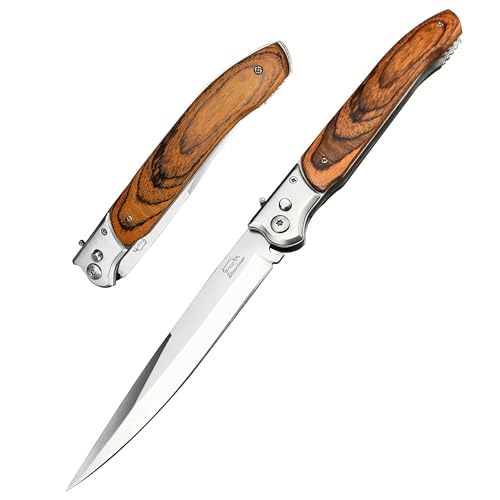
The HUAAO 12" Large Push Button Lock Pocket Knife is a substantial folding knife designed for outdoor enthusiasts and EDC users. With its assisted opening and secure lock, it aims to provide quick and safe blade deployment. Priced affordably, it offers a combination of size and features that appeal to those needing a heavy-duty cutting tool.
The SpeedSafe assisted slide mechanism allows for smooth one-handed opening, while the push button lock ensures the blade remains securely in place during use. The Pakkawood handle provides a warm, comfortable grip and aesthetic appeal. The included nylon sheath adds convenience for belt carry.
The knife has a large 12-inch overall length, indicating a substantial blade. The ambidextrous design accommodates both left and right-handed users. However, the lack of a pocket clip may be a drawback for those who prefer pocket carry without a sheath. The handle material is durable but requires hand washing, which might be less convenient.
Without user reviews, long-term durability is unknown. The blade steel is not specified, so edge retention may vary. The hand wash only care instruction suggests the handle is not fully waterproof or dishwasher safe.
For the price, the HUAAO 12" Push Button Lock Knife offers good value for outdoor tasks. Its assisted opening and secure lock are key advantages. If you need a large folding knife and don't mind carrying it in a sheath, this is a solid choice.
Color: Brown
Product Group: Sports
Binding: Unknown Binding

Pros
- Innovative 2-in-1 design saves space and adds utility
- Smooth automatic opening with push-button
- Stainless steel construction ensures longevity
- Compact 9-inch size fits easily in pocket or bag
- Variety of color options to suit personal style
Cons
- May not suit those preferring traditional combs
- Blade length is short for detailed hair work
- Limited to one comb per pack
The Rain smaller Switchblade Comb is a clever fusion of a hair comb and a pocket knife, designed for those who value both style and functionality. This 9-inch stainless steel comb features an automatic push-button mechanism that allows you to deploy the comb blade with a single click, making it ideal for quick touch-ups on the go. The wood grain finish adds a touch of elegance, while the blade itself is crafted for smooth, tangle-free brushing.
In real-world use, the comb performs admirably for basic grooming tasks. The stainless steel blade is sturdy and glides through hair without snagging, though it may not be as effective for very thick or long hair due to its 4-inch blade length. The push-button action is satisfying and reliable, though some users might find it takes a bit of practice to master the one-handed opening. The overall build feels solid, with a compact design that fits comfortably in hand or pocket.
One potential drawback is that the comb is primarily a novelty item rather than a full replacement for a dedicated hairbrush. The blade is more of a comb than a brush, so it won't provide the same detangling or volume as a traditional brush. However, for its price point, it offers good value as a conversation starter or a travel companion. The variety of colors, including marble and wood grain, allows for personalization.
Overall, the Rain smaller Switchblade Comb is a fun, functional gadget for anyone who appreciates innovative design. It's best suited for quick touch-ups, travel, or as a unique gift. While not a heavy-duty styling tool, it delivers on its promise of convenience and portability.
Color: Wood Grain
Size: 9 Inch (Pack of 1)
Blade Material: Stainless Steel
Comb Type: Folding Switchblade
Dimensions: Length 9 inches, Blade 4 inches, Handle 5 inches
Product Group: Beauty
Binding: Health and Beauty
Everything You Need to Know About Push Knives and Button Mechanisms
Grasping how push-activated blades operate requires looking past standard folding pocket knives and traditional fixed cutlery. The phrase refers to tools designed either to transfer linear force directly along the centerline of the blade or to deploy and lock cutting edges via an integrated push button or thumb slider. Examining the structural differences across these designs helps woodworkers, warehouse workers, and outdoor enthusiasts pick the right blade geometry for their daily cutting demands.
Defining the Push Blade: Origins, Force Transfer, and Geometry
A traditional push knife, often called a push dagger or punch blade, features a short blade mounted perpendicularly to a horizontal, T-shaped grip. The tang extends between the index and middle fingers, allowing the user to push directly forward with the full weight of the forearm behind the point. This layout originated as a personal defense tool in nineteenth-century riverboat communities because it offered exceptional retention and linear power in tight spaces.
The primary structural advantage of a perpendicular push handle lies in natural wrist alignment and skeletal support. When cutting or piercing forward with a standard knife handle, the wrist tends to bend slightly under heavy resistance, which creates joint strain. A push knife distributes force straight across the palm and aligns directly with the forearm bones, eliminating rotational torque at the wrist. This geometric efficiency lets the user apply significant pressure without gripping the handle with extreme tension.
In contemporary cutlery catalogs, the definition of a push knife has expanded beyond T-handle daggers to encompass push-button folders and push-slide utility cutters. Daily utility users frequently use the phrase to describe any edged tool where blade extension, lock disengagement, or cutting pressure relies on a direct push action. Recognizing these functional distinctions prevents confusion when evaluating specialized workshop and outdoor cutting gear.
Modern Push-Slider Utility Knives and Retractable Cutters
Retractable utility knives represent the most widely used modern interpretation of push-actuated cutting tools in commercial and home workspaces. These tools utilize an internal slider button mounted on the handle casing, allowing the operator to push the blade forward into multiple locked exposure positions. Sets like the DIYSELF 24 Pack Box Cutters, 9mm Razor Knife showcase this utility approach by pairing a narrow blade track with a ridged thumb slider that clicks into place securely during repetitive cutting jobs.
The ratcheting lock inside a push-sliding utility knife plays a critical role in user safety and cutting accuracy. When the slider is pushed forward, internal spring tabs ride over molded teeth along the channel, snapping into detents that resist backward force. Reversing the rear locking tab secures the blade extension, preventing the segmented razor from slipping back into the body when slicing dense corrugated cardboard. This mechanical stability allows workers to score materials with consistent blade depth.
Segmented snap-off blades give push-slide utility tools a distinct advantage over solid utility blades by providing instant edge renewal. The narrow nine-millimeter blade strips feature pre-scored diagonal lines across their length, creating individual cutting segments that snap off when dull. An integrated blade snapper tool located at the rear of the handle allows users to break away worn segments safely. This feature eliminates the need for manual sharpening during long packaging sessions, keeping the working apex keen.
Push-slider knives excel in tasks that demand controlled tip scoring rather than heavy slicing along a wide blade belly. Warehouse workers use them to slice box tape and shrink wrap without puncturing fragile merchandise stored underneath. Crafters and model builders rely on the rigid point to trim cardstock, shave balsa wood, and sharpen drafting pencils cleanly. Because the handle remains lightweight and slim, users maintain delicate fingertip control.
Push-Button Locks and Assisted Folding Blade Mechanisms
Folding pocket knives that utilize push-button locks represent another common category associated with the push knife terminology. Instead of relying on a traditional liner lock that requires pushing a metal leaf sideways inside the blade well, button-lock folders release via a spring-loaded plunger. Models such as the HUAAO 12″” Large Push Button Lock Pocket Knife incorporate a dedicated button on the handle scale that directly interfaces with the blade tang, permitting smooth assisted opening or fast one-handed closure.
Speed-assisted deployment systems often pair with push-button mechanisms to create fast, reliable blade presentation. An internal torsion bar or coil spring biases the blade toward the open position once the lock is cleared, propelling the blade forward into full lockup. To prevent accidental deployment inside a pocket or equipment pack, well-designed models incorporate a sliding safety lock next to the pivot button. This secondary slide blocks button travel, ensuring the folding knife remains securely closed.
The push-button mechanism also appears in novelty, grooming, and training tools that mimic the action of traditional switchblades without presenting sharp cutting hazards. The Rain smaller Switchblade Comb Pocket Knife Hair Brush Automatic exemplifies this mechanism by using a spring-loaded button to deploy a folding barber comb. These grooming tools use identical internal spring latches and release triggers as automatic knives, providing familiar tactile feedback. The mechanism demonstrates how push-activated deployment serves practical grooming functions with vintage styling.
Mechanics of Push Cutting Versus Draw Slicing
Understanding the physical mechanics of push cutting reveals why certain blade shapes and grinds suit specific workshop and outdoor tasks. A true push cut occurs when the blade edge is pressed directly into a material perpendicular to the surface without any sliding motion. Chisels, wood carving gouges, and straight razor edges function purely on push-cutting principles, cleaving material fibers through wedge action and direct pressure. In contrast, draw slicing moves the blade laterally across fibers.
Edge geometry dictates how effectively a blade performs push cuts compared to draw cuts. Push cutting demands an acute edge bevel, usually ground between twelve and fifteen degrees per side, combined with a thin cross-section directly behind the cutting apex. A thick blade spine or blunt edge profile creates excessive resistance when pushed straight into dense media, causing the material to wedge and split unevenly. Fine push cuts also require a polished, uniform edge apex.
Cutting board selection and backing surfaces become crucial when executing continuous push cuts. Because all downward force concentrates on the exact point or flat section contacting the base, hard cutting surfaces like glass or ceramic will roll or dull the edge immediately. Soft end-grain hardwood blocks or food-grade polyethylene mats cushion the apex at the end of the stroke, preserving sharpness across many cutting cycles and preventing frustrating edge deformation.
Metallurgy and Blade Steel in Push-Operated Cutters
The metallurgical demands on push-operated cutting edges differ significantly from the requirements of standard kitchen slicing knives. Utility snap-off cutters rely on high-carbon tool steels that achieve high Rockwell hardness ratings, often reaching sixty HRC or higher. This elevated hardness provides an exceptionally rigid apex that resists bending when pushed through dense cardboard or heavy plastic strapping. Carbon steel holds an acute razor edge longer under direct compressive loads, though it requires dry storage to prevent rust.
Folding pocket knives with push-button locks frequently utilize high-grade stainless alloys that balance edge toughness with corrosion protection. Stainless steels alloyed with molybdenum and vanadium form fine carbide structures that resist micro-chipping along the cutting bevel. Because push-button folding blades encounter outdoor weather and pocket moisture, stainless composition prevents unsightly surface pitting and pivot corrosion. Ambidextrous folders built for outdoor use benefit from these alloys, keeping maintenance manageable with simple hand cleaning.
Compressive stress during heavy push cuts can cause ductile edge rolling if the heat treatment leaves the steel too soft. When an edge rolls, the microscopic apex folds sideways away from the cut line, causing the blade to slide off the material rather than biting into it. Conversely, excessively brittle steel exposed to lateral twisting while pushed into dense wood will suffer micro-chipping along the bevel. Proper heat treatment balances hardness and shock absorption effectively.
Blade maintenance strategies differ between disposable push cutters and permanent folding knives. With segmented razor knives, users avoid stone sharpening entirely by detaching worn segments or swapping fresh replacement blades into service. Folding push-button knives, on the other hand, require periodic whetstone upkeep or ceramic rod touch-ups to restore edge geometry. Polishing the bevel on fine waterstones creates a smooth, razor-like apex that minimizes pushing friction through tough workpieces.
Ergonomic Grip Profiles, Tang Styles, and Handle Security
Ergonomic handle contours directly influence how much linear power a user can safely exert without hand slippage or joint strain. In T-handle push daggers, the cross-grip fills the palm cavity, allowing the fingers to wrap around the horizontal bar like a clenched fist. In folding push-button knives and straight utility cutters, the handle must feature pronounced finger grooves and textured scales to keep the palm from sliding forward over the sharpened edge.
Handle materials contribute substantially to grip retention and tactile feedback during wet, greasy, or cold working conditions. Many modern push-button folders incorporate treated Pakkawood, layered G10 laminates, or textured synthetic polymers that resist moisture intrusion. Craftspeople selecting knife handle materials often evaluate bone, dense hardwood, and composite resins for their long-term structural resilience and natural hand feel under heavy cutting pressure. A non-slip handle surface ensures steady blade control at all times.
Tang design and pivot construction determine how well an edged tool handles forward force without catastrophic structural failure. Traditional fixed push knives utilize a robust full tang running from the blade through the center of the perpendicular grip, eliminating weak structural joints. Folding knives, however, transfer all pushing force directly through the pivot pin, lock plunger, and internal stop pins. Selecting folders with thick stainless pivot hardware prevents lock failure during rigorous daily utility tasks.
Wrist positioning remains an essential consideration for users performing repetitive cutting tasks across long work shifts. Pushing a blade with an awkwardly bent wrist forces forearm tendons to work at an unnatural mechanical angle, leading to repetitive strain injuries and rapid muscle fatigue. Proper handle sizing allows the user’s wrist to remain locked straight, channeling cutting momentum through the arm. Selecting a handle that matches your palm width ensures continuous safety.
Safe Operation, Lock Maintenance, and Storage Practices
Operating any push knife safely begins with disciplined body mechanics and mindful blade path management. Users should always cut away from the body, keeping the non-dominant guiding hand firmly behind the blade’s travel path at all times. When working with retractable razor cutters, extend only enough blade segments to clear the material thickness, as over-extending thin blades increases flexing and breakage risks. Wearing cut-resistant work gloves adds an essential layer of personal protection against slips.
Maintaining push-button locking mechanisms and slider tracks requires regular cleaning to remove airborne dust, pocket lint, and adhesive residue. Corrugated cardboard shedding and packing tape gum can accumulate inside slider channels and button plungers, causing locking detents to fail or stick unexpectedly. Periodically blowing out the pivot cavity with compressed air and applying a tiny drop of non-gumming synthetic oil keeps the internal springs operating smoothly. Avoid heavy grease, which attracts abrasive grit.
Safe storage practices protect both the sharpened blade apex and curious hands in workshops or living areas. Retractable utility knives should always have their blades drawn fully into the protective body before being placed on workbenches or toolboxes. Folding push-button knives should be secured in their dedicated nylon sheaths or carried securely clipped inside deep pockets with the slide safety engaged. Always direct spent razor segments into a puncture-proof container during blade changes.
Matching blade mechanics to your cutting task ensures peak performance, whether a project calls for the instant edge renewal of a utility cutter, the fast deployment of a push-button folder, or the unique force transfer of a T-handle blade. Prioritizing durable locking systems, ergonomic handle scales, and sound cutting habits allows you to tackle demanding slicing and scoring jobs with confidence. Investing in reliable blade construction ultimately delivers long-lasting cutting efficiency while keeping hand fatigue minimal.




Write Your Review
No reviews yet. Be the first to share your experience!