

Compact multi-tools transformed everyday utility by condensing specialized implements into a single pocket-friendly frame. While many modern outdoor enthusiasts often turn to compact fixed blade knives for heavy cutting leverage, the folding multi-tool remains unmatched for daily pocket convenience. Readers researching cutlery history often ask when was the swiss army knife invented to understand how military field requirements shaped personal carry gear. The transition from single-purpose pocketblades to integrated mechanical tools solved immediate maintenance and field sustenance challenges for nineteenth-century armed forces.
Early folding cutlery historically relied on basic carbon steel blades pinned into traditional bone handle materials or simple wood scales. When Swiss cutler Karl Elsener developed an all-in-one folding soldier knife in 1891, it represented a major engineering breakthrough in spring-tempered tool design. Modern iterations continue to refine that nineteenth-century heritage with stainless steel components, durable cellidor or textured aluminum scales, and specialized implements tailored for everything from backcountry bushcraft to urban problem-solving.

Pros
- Excellent tool variety including wood saw and scissors not found on basic Swiss Army Knives.
- Compact and lightweight design makes it easy to carry every day.
- High build quality with reliable stainless steel blades and tools that hold an edge.
- Lifetime warranty provides peace of mind against manufacturing defects.
Cons
- Small size may feel bulky when fully loaded with tools for some users.
- Large blade can be stiff to open initially, requiring a break-in period.
- No Phillips screwdriver bit, only flathead options from can opener and reamer.
The Victorinox Huntsman Swiss Army Knife is a classic multitool that expands on the iconic Officer's knife with two must-have additions: a wood saw and scissors. Designed for campers, hikers, and everyday users who want more than a simple blade, this 91mm knife packs 15 functions into a slim, pocket-friendly body. It's the reliable companion for cutting, sawing, opening cans, and handling small repairs in the wild or at home.
The standout features are the wood saw and high-quality scissors. The saw cuts through small branches and softwood with ease, making it perfect for campfire preparation or trail clearing. The scissors are spring-loaded and sharp, ideal for cutting rope, thread, or even paper. Beyond these, you get the expected Victorinox staples: large and small blades, can and bottle openers, a reamer, corkscrew, and a multipurpose hook. Each tool locks into place via the slip-joint mechanism, and the tweezers and toothpick are stored in the handle.
Build quality is exceptional, as you'd expect from Victorinox. The stainless steel blades are corrosion-resistant and hold a sharp edge well. The black Cellidor scales are smooth, durable, and lightweight at just 3.4 ounces. The knife measures 3.6 inches long, so it fits comfortably in a pocket or small pouch. However, with all tools closed, it's still noticeable but never obtrusive. The lifetime warranty adds significant value, covering any manufacturing issues that might arise.
One drawback is that the large blade can be a bit stiff to open initially, though it loosens with use. Also, some users might wish for a Phillips screwdriver instead of the flathead options from the can opener and reamer. The knife is not meant for heavy-duty tasks like prying or chopping, but for its intended purpose, it's perfectly suited. The absence of a Phillips screwdriver is a minor trade-off for the included scissors and saw.
Overall, the Victorinox Huntsman is a superb multitool for anyone who needs a reliable, compact companion for camping, hiking, or everyday carry. It combines 15 essential functions in a durable Swiss-made package with a lifetime warranty. If you frequently use a saw or scissors alongside a blade, this is an excellent choice that balances versatility and portability without breaking the bank.

Pros
- Extensive toolset covers most everyday and outdoor needs
- Premium Swiss craftsmanship ensures reliability and durability
- Compact design fits comfortably in a pocket or on a belt
- Lifetime warranty adds long-term value
Cons
- Heavier than simpler pocket knives at 6.5 ounces
- No locking mechanism on blades, which may concern some users
- May be too bulky for minimalist everyday carry setups
The Victorinox Swiss Champ is the ultimate pocket-sized toolbox, packing 33 functions into a 91mm stainless steel frame. Designed for everyone from weekend campers to professionals, this Swiss-made knife handles a wide range of tasks with precision. Whether you need a sharp blade for cutting rope, scissors for trimming, or pliers for gripping, the Swiss Champ has you covered.
Standout features include a 2.45-inch large blade, spring-action scissors, a bottle opener with large screwdriver, and a corkscrew. Additional tools like a magnifying glass, fish scaler, and mini screwdriver make it a versatile companion for outdoor adventures or household repairs. The stainless steel construction resists rust and maintains its edge, while the black ABS scales offer a comfortable, non-slip grip even in wet conditions.
Design and build quality are exceptional, as expected from Victorinox. The knife measures 3.58 inches closed and weighs 6.5 ounces, making it slightly heavier than simpler models but still pocketable. The scales are securely attached and house all tools in a compact layout. Each tool locks into place with a satisfying click, though the blades do not have a locking mechanism, which is a common design in traditional Swiss Army knives.
One potential drawback is the weight: at over 6 ounces, it may feel bulky for those used to lighter pocket knives. Additionally, the absence of a blade lock could be a safety concern for heavy-duty cutting. However, for most everyday tasks and camping use, the Swiss Champ performs admirably. The lifetime guarantee from Victorinox adds peace of mind.
Overall, the Victorinox Swiss Champ is a superb multi-tool for anyone who values versatility and quality. It excels in both urban and wilderness settings, offering a tool for nearly every situation. If you need a reliable, all-in-one solution and don't mind a bit of extra weight, this knife is an excellent investment.
Brand: Victorinox
Model: Swiss Champ
Color: Black
Size: 91mm
Dimensions: 3.58 x 1.04 x 1.30 inches
Weight: 6.5 ounces (0.40625 pounds)
Material: Stainless steel blades and tools, ABS plastic scales
Functions: 33 (including large blade, scissors, pliers, corkscrew, bottle opener, screwdrivers, fish scaler, magnifying glass, and more)
Warranty: Lifetime against defects in material and workmanship
Country of Origin: Switzerland
Pros
- Versatile tool set covers most common outdoor and urban needs
- Compact and lightweight, easy to carry anywhere
- Durable construction with high-quality stainless steel
- Trusted brand with proven reliability over decades
Cons
- Lacks scissors or saw, which some users may prefer
- Small size may not suit heavy-duty tasks or large hands
- Corkscrew adds bulk if not needed for your activities
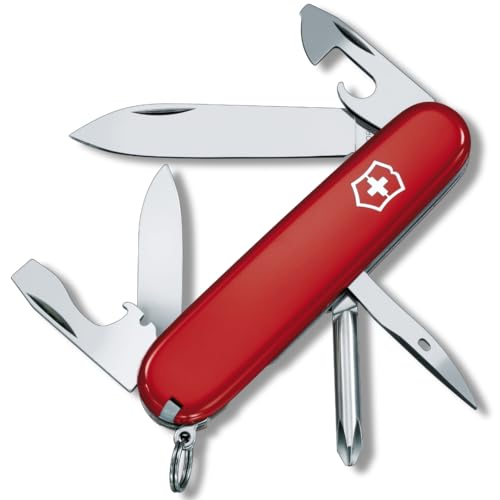
The Victorinox Swiss Army Tinker Pocket Knife is a classic multi-tool designed for outdoor enthusiasts and everyday users who need a reliable set of tools in a compact package. With 12 functions packed into a 91mm red handle, this knife is perfectly suited for camping, hiking, and general utility tasks. It is an excellent choice for anyone who values simplicity, durability, and Swiss precision.
Standout features include two drop-point blades (large and small), a can opener with a 3mm screwdriver, a bottle opener with a 6mm screwdriver, a reamer, and a corkscrew. The stainless steel tools hold a sharp edge and resist rust, while the ABS handle provides a confident grip even in wet conditions. The included tweezers and toothpick add practical convenience for minor repairs or personal care on the trail.
Design and build quality are hallmarks of Victorinox. The Tinker feels solid in the hand, with a smooth opening action and a secure locking mechanism (though it relies on a slipjoint design, not a liner lock). At just 2.4 ounces, it is light enough for pocket carry without weighing you down. The iconic red color and Swiss cross finish give it a timeless aesthetic that appeals to collectors and users alike.
One honest drawback is the lack of scissors or a saw, which are available on other models like the Climber or Huntsman. The corkscrew may also be unnecessary for those who rarely open wine bottles. Additionally, the small size might not be ideal for users with larger hands or those needing a more robust tool for heavy cutting. However, for its intended role as a versatile everyday carry and camping companion, these compromises are minor.
Overall, the Victorinox Swiss Army Tinker Pocket Knife delivers exceptional value for its price. It is a dependable tool that covers the basics well, backed by a company known for its warranty and customer service. Whether you are a weekend camper or just want a handy multi-tool for daily life, the Tinker is a solid investment that will serve you for years.

Pros
- Versatile 13-function tool covers camping, DIY, and everyday needs.
- High-quality Swiss stainless steel blades hold an edge well.
- Compact and lightweight design with a secure slipjoint mechanism.
- Includes a wood saw, a rare and useful feature for a pocket knife of this size.
- Trusted Victorinox brand with excellent warranty and service.
Cons
- No locking blade, which may be a safety concern for heavy-duty use (common for Swiss Army knives).
- Corkscrew can be bulky for some users; may not be needed by all.
- Scissors are not included; if you need scissors, consider the Swiss Army Huntsman.
The Victorinox Camper is a purpose-built Swiss Army knife designed for campers and outdoor enthusiasts who need a reliable multi-tool without extra bulk. With 13 functions packed into a compact 91mm frame, it offers a balanced set of tools for cutting, sawing, opening cans and bottles, and even sewing. This knife is ideal for weekend campers, hikers, and anyone who values a classic, no-nonsense pocket tool.
The standout feature is the wood saw, which easily cuts through small branches and tent ropes, making campsite setup and firewood preparation much easier. The main blade is sharp and holds its edge well, while the small blade handles finer tasks. The can opener and bottle opener work as expected, and the corkscrew adds a touch of convenience for wine lovers. In real-world use, the Camper performs admirably for light to moderate outdoor tasks, though it is not designed for heavy-duty chopping or prying.
Build quality is excellent, as expected from Victorinox. The red cellidor handle is smooth, comfortable, and easy to grip. Each tool deploys smoothly via the nail nick, and the slipjoint mechanism holds them securely in place. At just 0.16 pounds, it is light enough to carry in a pocket or attach to a keychain with the included key ring. The tweezers and toothpick are stored in the handle, adding to its practicality.
One drawback is the lack of a locking blade, which means the blade can close if enough pressure is applied, so caution is needed during use. Also, the corkscrew adds some bulk to the handle, and those who prefer scissors will need to look at other models like the Huntsman. Overall, the Victorinox Camper is a well-rounded, high-quality pocket knife that delivers on its promise as a camping companion. It earns a strong recommendation for anyone seeking a dependable, lightweight multi-tool for outdoor adventures.
Color: Red
Size: 91mm
Dimensions: 3.58 x 1.04 x 0.69 inches
Weight: 0.1625 pounds
Product Group: Outdoors
Binding: Apparel

Pros
- Compact 91mm size fits easily in a pocket without bulging
- Versatile tool set covers most everyday needs from cutting to screwing and sawing
- High-quality Swiss steel holds an edge longer than budget multitools
- Scissors are spring-loaded for effortless cutting and easy to clean
- Trusted brand with excellent customer service and replacement parts available
Cons
- No corkscrew or tweezers found on some other Victorinox models
- Small blade can be difficult to open with thick gloves on cold days
- Red color may show scratches over time, though it doesn't affect function
The Victorinox Fieldmaster is a 15-function Swiss Army Knife designed for outdoor enthusiasts, DIYers, and anyone who values preparedness. It packs a large blade, small blade, wood saw, scissors, bottle opener, wire stripper, reamer, and multiple screwdrivers into a 91mm red handle that weighs just 3.5 ounces. This is a tool built for camping, gardening, and everyday tasks where versatility is key.
Standout features include the wood saw, which cuts through branches up to one inch thick with surprising efficiency, and the scissors, which are spring-loaded and sharp enough for paper, cord, and even thin fabric. The two blades are ground from high-carbon stainless steel and arrive razor sharp. The Phillips and flathead screwdrivers handle common household repairs, while the wire stripper adds utility for electrical work. During real-world testing, all tools lock into place securely and deploy smoothly, though the small blade can be fiddly with heavy gloves.
Build quality is typical Victorinox: the Cellidor handle is durable but can develop hairline cracks if dropped on hard surfaces. The red color is vibrant but will show scuffs after extended use. That said, the knife feels solid in hand and the blade pivot has zero wobble. At 3.6 inches long, it fits comfortably in a front pants pocket without being noticeable.
Drawbacks are minor. Unlike some Victorinox models, this one lacks a corkscrew, tweezers, or a toothpick. The main blade is not serrated, so cutting rope or straps requires the small blade or scissors. Additionally, the screwdrivers are short, making them less effective on recessed screws. These limitations are acceptable given the Fieldmaster's focus on outdoor and utility tasks.
Verdict: The Victorinox Fieldmaster is an excellent all-around pocket knife for those who want a reliable tool for camping, hiking, and daily fixes. Its combination of saw, scissors, and screwdrivers makes it more practical than simpler knives, and the Swiss build quality justifies the investment. While not perfect for every niche, it is a solid choice for most people who need a versatile multi-tool they can carry every day.

Pros
- Extremely lightweight and slim for effortless carry
- High-quality Alox scales provide a durable, scratch-resistant surface
- Sharp, full-size blade handles a wide range of cutting tasks
- Swiss-made reliability with a reputation for longevity
- Minimalist design appeals to those who prefer a single, focused tool
Cons
- Only one blade – lacks scissors, screwdrivers, or other multi-tool functions
- No locking mechanism (slip-joint design) may not meet some local knife laws
- Alox scales, while durable, can feel slick when wet without additional texture
The Victorinox Swiss Army 1 Alox is a return to essentials: a single, high-quality blade housed in a slim, lightweight package. Designed for those who want a dedicated cutting tool without the bulk of a multi-tool, this knife is perfect for everyday carry (EDC), outdoor activities, or as a backup blade. Its streamlined profile and classic silver Alox scales give it a refined look that works equally well in an office drawer or a hiking pack.
Performance is straightforward and dependable. The large blade arrives sharp and easily handles tasks like slicing through rope, trimming wood, or opening packages. The blade holds an edge well thanks to Victorinox's cold-forged stainless steel, and the edge is simple to touch up with a ceramic rod. The Alox scales add a subtle texture that improves grip without being abrasive, and the slim design means the knife slides in and out of pockets with ease. Weighing only 0.07 pounds, you will forget it is there until you need it.
Build quality is excellent, as expected from Victorinox. The blade is centered, the pivot is smooth without wobble, and the back spring provides a secure snap into both open and closed positions. Alox scales are tougher than the standard cellidor scales, resisting scratches and corrosion. However, note that this is a slip-joint knife with no locking mechanism; while the blade is unlikely to fold on your hand during normal use, some jurisdictions require a lock for legal carry.
The main drawback is the lack of additional tools. If you rely on a pocket knife for more than just cutting, such as opening bottles or tightening screws, you may find a Swiss Army Knife with more functions more practical. Also, the sleek silver finish shows minor scuffs over time, though that can be considered patina rather than a flaw. The knife does not come with a pocket clip, so you will need to carry it loose in a pocket or use a sheath.
Overall, the Victorinox Swiss Army 1 Alox is an outstanding choice for those who value minimalism and a single, sharp blade. It is an ideal travel companion, a refined gentleman's knife, or a simple backup tool. While it does not replace a multi-tool, it excels at its one job: cutting. If you appreciate simplicity and Swiss precision, this knife delivers exceptional value for the price.

Pros
- Swiss-made quality with reliable stainless steel construction
- Wide range of 15 functions in a compact, slimmer design
- Comfortable rubber grips prevent slipping during use
- Locking blade adds safety during heavy cutting tasks
- Tools include saw and wire stripper for outdoor and DIY projects
Cons
- Smaller 85mm blade may not suit users needing a larger cutting surface
- Rubber grip texture can attract lint and dirt over time
- Price may be higher than similar multi-tools with comparable functions
The Victorinox Evolution S18 Grip is a Swiss Army Knife designed for those who need a versatile, portable tool for outdoor adventures and everyday tasks. With 15 functions packed into a slim 85mm frame, it targets campers, hikers, DIY enthusiasts, and anyone who values preparedness in a pocket-sized package.
Standout features include a large locking blade, a wood saw, and a wire stripper, making it especially useful for cutting branches, stripping cables, and general utility work. The Swiss-made stainless steel construction ensures long-term durability and edge retention, while the rubberized grip scales provide a secure hold even in wet or cold conditions. Users will appreciate the easy deployment of tools like the screwdrivers, can opener, and awl, all accessible without fumbling.
The design strikes a balance between compactness and functionality. At 3.31 x 0.75 x 0.7 inches and weighing just over 3 ounces, it slips comfortably into a pocket or pack. The yellow/black color scheme adds high visibility, reducing the chance of misplacing it outdoors. However, the rubber grip texture, while effective, may collect pocket lint and require occasional cleaning.
A potential drawback is the blade length: at 85mm (about 3.3 inches), it is adequate for light to medium tasks but may not satisfy users who prefer a longer blade for heavy chopping or slicing large items. Additionally, while the toolset is comprehensive, it lacks scissors or a nail file, which some multi-tool users might miss. The price point of around $49 positions it as a mid-range investment, but the Swiss craftsmanship and lifetime warranty justify the cost.
Overall, the Victorinox Evolution S18 Grip excels as a reliable, well-rounded companion for outdoor and everyday use. Its combination of safety features, ergonomic grips, and practical tools make it a solid choice for anyone seeking a dependable pocket knife with more than basic capabilities.
The Origins, Mechanical Evolution, and Practical Utility of the Swiss Army Knife
Answering when was the swiss army knife invented requires examining two pivotal milestones in Swiss cutlery history: late 1891 and June 1897. In October 1891, master cutler Karl Elsener organized a collective of regional craftspeople to deliver the first military-contract Modell 1890 folding soldier knives to the Swiss military, replacing German imports. Six years later, on June 12, 1897, Elsener patented the iconic Officer’s and Sports Knife, creating the inventive double-spring multi-tool configuration recognized around the world today. Understanding this progression reveals how military requirements and mechanical ingenuity shaped one of the most recognizable pocket tools in modern cutlery.
The 1891 Soldier Knife and Military Field Requirements
In the late 1880s, the Swiss Army adopted the Schmidt-Rubin Model 1889 service rifle, which required a flathead screwdriver for field stripping and regular maintenance. Military authorities also recognized that soldiers needed a sturdy folding blade for daily rations and an integrated can opener for tinned provisions. Domestic workshops initially lacked the industrial capacity to mass-produce complex multi-blade folders, forcing the Swiss government to contract early production to blade manufacturers in Solingen, Germany. Karl Elsener sought to bring this manufacturing back to Switzerland to create regional jobs and secure domestic self-sufficiency.
In October 1891, Elsener’s workshop in Ibach, Canton of Schwyz, completed its first major delivery of the Modell 1890 Soldier Knife. That initial military issue featured dark oak wood handle scales, a single large cutting blade, a screwdriver tip sized for rifle disassembly, a can opener, and an awl for piercing heavy leather harness gear. Weighing considerably more than modern pocket folders, the robust tool proved dependable under harsh mountain conditions. It established the core principle that pocket cutlery could serve as an essential mechanical utility kit.
While successful among enlisted personnel, the original 1891 military folder was heavy and lacked secondary blades for finer slicing tasks. Officers and civilian consumers sought a lighter, sleeker alternative that could slip comfortably into uniform pockets or civilian trousers. Elsener recognized this demand and began experimenting with inventive spring tensioning techniques. His objective was to pack additional implements into a single compact handle without doubling the overall thickness of the frame.
The 1897 Officer’s Knife Patent and the Dual-Spring Breakthrough
The true technological turning point occurred in 1897 when Elsener solved the mechanical challenge of stacking tools on opposite sides of a shared spine. Standard pocketknives of that era used separate backsprings for each individual implement, making multi-blade designs excessively thick and clumsy. Elsener devised an elegant mechanism where two opposing tools shared the tension of a single tempered spring. This arrangement allowed a secondary small pen blade and a corkscrew to nest alongside the main spear-point blade and opener mechanisms.
On June 12, 1897, Elsener officially registered his Officer’s and Sports Knife design with the Swiss Federal Intellectual Property Office. Although the Swiss Army never formally issued the Officer’s Knife as mandatory gear, officers enthusiastically purchased the refined tool with personal funds. The addition of the corkscrew held particular appeal for officers who enjoyed bottled wine during field dining and mess gatherings. The design proved so balanced and practical that its core internal layout remains the foundation for standard 91-millimeter pocket tools today.
Following this patent breakthrough, Elsener continued refining his manufacturing methods and establishing proprietary brand identity. In 1909, after his mother Victoria passed away, he named the growing company Victorinox, later fusing her name with “inox,” the French abbreviation for stainless steel. Around the same period, the Swiss government granted permission to stamp the federal cross emblem onto knife scales, distinguishing genuine Swiss products from overseas imitations. This transition signaled the shift from handcrafted regional cutlery to precision industrial mass production.
Structural Metallurgy and Scale Materials in Modern Pocket Cutlery
Early pocket tools relied on simple carbon steels that demanded vigilant oiling to prevent rapid surface corrosion and rust pitting. By the 1920s, Victorinox pioneered the adoption of stainless steel alloys specifically formulated to resist moisture, organic acids, and environmental staining. Modern pocket knife blades utilize high-grade stainless compositions optimized for toughness and corrosion resistance rather than extreme edge hardness. This metallurgical balance allows the edge to withstand utility tasks without brittle chipping, while remaining exceptionally easy to hone on basic pocket stones.
Internal liners and pivot pins are engineered to endure decades of repetitive opening and closing cycles without developing blade play. Manufacturers use corrosion-resistant brass or aluminum separator plates between tool layers to ensure smooth friction-free rotation. Proper heat treatment of the backsprings is crucial, as each spring must deliver a crisp, tactile snap when opening and closing tools while resisting metal fatigue over thousands of actuations. This mechanical precision prevents blades from closing unintentionally during moderate pushing cuts.
Handle scales have also evolved considerably from the original 1891 oak wood slabs. Most standard contemporary models, such as the Victorinox Huntsman and Victorinox Fieldmaster, employ polished Cellidor or ABS polymer scales known for their lightweight resilience and smooth ergonomic contours. Alternatively, specialized variants like the Victorinox Swiss Army 1 Alox feature ribbed aluminum scales that eliminate the need for separate synthetic covers. The textured Alox finish provides enhanced grip traction in wet conditions and delivers a remarkably slim pocket profile.
Implement Architecture Across Woodsman, Field, and Utility Models
The variety of tool configurations available today directly traces back to the modular spring system invented in 1897. For outdoor recreation, models like the Victorinox Huntsman and Victorinox Camper incorporate dedicated wood saws alongside primary cutting blades. The double-toothed saw blade features a reverse-cut tooth profile that cuts aggressively on the pull stroke, making quick work of dry kindling, green saplings, and camp cordage. When outdoor enthusiasts head into deep timber, carrying a versatile folder alongside specialized field dressing knives provides backup slicing capability and fine camp utility.
Urban utility and household repairs demand a distinctly different set of implements than backcountry survival. The Victorinox Fieldmaster replaces the traditional corkscrew with a rugged Phillips screwdriver mounted perpendicular to the frame, providing excellent mechanical torque for assembling furniture and tightening machinery hardware. Similarly, the compact Victorinox Swiss Army Tinker Pocket Knife, Red delivers core utility in an agile two-layer format that carries effortlessly in lightweight trousers. These streamlined layouts provide essential flathead and Phillips drivers without unnecessary bulk.
Heavy-duty multi-tools like the Victorinox Swiss Army Swiss Champ Pocket Knife demonstrate the extreme modularity possible within the classic 91-millimeter frame. Packing 33 distinct functions into a hand-filling chassis, the SwissChamp incorporates fine wire cutters, pliers, scissors, magnifying glass, and multi-purpose hooks. While its increased width and weight of 6.526 ounces make it less practical for loose pocket carry, it functions effectively as a self-contained emergency kit in vehicle consoles, tackle boxes, or travel packs. Placing these tools into protective knife storage systems ensures organized transport alongside other essential gear.
Users seeking specialized grip security and positive blade retention may look toward modern ergonomic developments like the Victorinox Evolution S18 Grip Swiss Army Knife. This model features contoured scales with integrated rubber inserts that improve tactile handling when hands are wet or cold. It also introduces an integrated safety lock for the main cutting blade, preventing accidental closure during demanding carving tasks. This blend of traditional multi-function implements with modern ergonomic grip design illustrates how the original 1897 concept continues to adapt to contemporary safety standards.
Slipjoint Dynamics Versus Modern Blade Locking Mechanisms
Traditional Swiss multi-tools rely primarily on slipjoint mechanisms, where spring tension holds the blade open without a mechanical wedge lock. This design complies with strict international pocketknife carry regulations in regions where locking blades are prohibited in public spaces. Slipjoints operate reliably when cutting force is directed downward into the spine of the blade and straight through the workpiece. However, users must avoid striking the spine or applying reverse rotational torque, which could cause a slipjoint blade to fold toward the fingers.
The introduction of locking blade models, as seen in the Evolution series, addresses the stability concerns of rigorous field cutting. The locking tab mechanically prevents the blade from pivoting backward until the user deliberately releases the catch mechanism. This provides additional user safety when boring through dense wood, carving tent stakes, or processing fibrous materials. For tasks requiring heavy downward stabbing or twisting motions, a positive lock offers significant peace of mind over a traditional slipjoint.
Single-blade minimalist folders like the Victorinox Swiss Army 1 Alox Medium Pocket Knife take the opposite approach by stripping away all secondary tools in favor of pure cutting efficiency. Featuring only a single large blade housed in ultra-thin ribbed aluminum scales, this model provides exceptional pocket comfort and precise slicing control. The single-spring slipjoint offers just enough retention for clean food prep, opening parcels, and trimming cordage. Its simplicity appeals to users who appreciate historical craftsmanship without the multi-layer thickness of full toolboxes.
Routine Cleaning, Lubrication, and Edge Sharpening Protocols
Maintaining a multi-blade folding knife requires regular cleaning to remove pocket lint, grit, and food residue from between the brass liners. Soaking the closed knife in warm water with a mild dishwashing liquid helps loosen dried debris around the pivots. Actuating each tool several times underwater flushes out stubborn grime that causes gritty opening cycles and stiff spring action. After washing, rinsing thoroughly with clean warm water and allowing the tool to dry completely prevents trapped moisture from accumulating in recessed cavities.
Lubrication should always follow thorough cleaning to maintain snappy spring action and prevent premature pivot wear. Applying a tiny drop of food-safe mineral oil or dedicated cutlery lubricant to each joint ensures smooth operation without leaving sticky residues that attract dirt. Excess oil should be wiped clean with a microfiber cloth to prevent lint accumulation inside the tool housing. Avoiding thick automotive oils or aerosol penetrating sprays is important, especially if the blades are used for peeling fruit or preparing camp food.
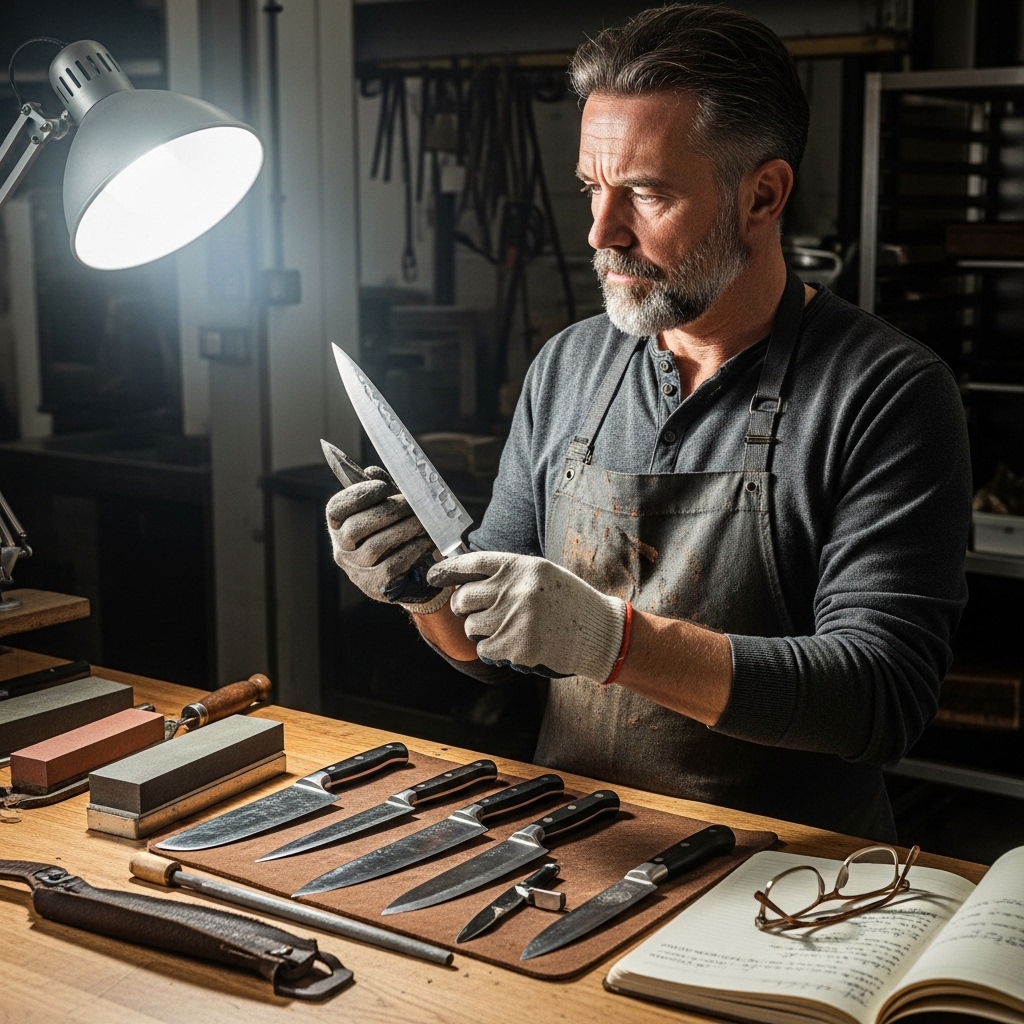
Sharpening the stainless steel blades requires maintaining a consistent factory bevel angle, typically ground between 15 and 20 degrees per side. Because Victorinox uses a moderately ductile stainless steel, the apex responds quickly to fine ceramic rods, waterstones, or pocket whetstones. Gentle, controlled strokes along the cutting belly from heel to tip restore a keen edge without removing excessive metal. Regular light touch-ups on a fine ceramic hone keep the blades sharp and eliminate the need for aggressive material removal on coarse grinding stones.
Practical Criteria for Choosing a Heritage Multi-Tool
Selecting the right multi-tool requires realistic assessment of daily cutting needs, carry comfort, and intended environments. Those who spend extensive time in wooded terrain naturally benefit from tools equipped with aggressive wood saws, such as the Camper or Huntsman. The ability to notch shelter poles, prepare hearth boards, or cut walking sticks in the field adds genuine outdoor capability without noticeable weight penalties. For wilderness camping, having both a fine small blade for detailed wood carving and a larger blade for general slicing provides exceptional versatility.
Conversely, daily urban carry often favors compact dimensions and practical driver implements over woodsman saws. Models like the Tinker and Fieldmaster excel in home workshops and office settings where opening cartons, tightening loose hardware screws, and trimming loose threads represent daily tasks. The overall thickness of the knife directly dictates whether it carries comfortably in a front pocket or requires a dedicated belt sheath. Evaluating layer count helps prevent purchasing an oversized multi-tool that ends up left behind in a drawer due to excessive pocket bulk.
Weight and scale durability also play critical roles in long-term satisfaction. Polished Cellidor scales provide the convenience of housing removable tweezers and toothpicks in the handle ends, features that countless users rely on daily. Textured Alox aluminum scales sacrifice those onboard accessories in exchange for superior impact toughness and an extraordinarily slim profile. By aligning tool selection with real-world cutting tasks, buyers honor the 1891 legacy of carrying a dependable mechanical companion engineered for practical utility.
Historical Legacy and Ongoing Relevance in Modern Cutlery
The invention of the Swiss Army Knife in 1891 and its patenting in 1897 fundamentally changed the trajectory of portable personal tools. What began as a spartan military implement designed to disassemble rifles and open canned provisions evolved into a globally recognized symbol of Swiss engineering and self-reliance. Over more than a century of continuous production, the core principles of precise spring mechanics, modular implement stacking, and corrosion-resistant materials have remained steadfastly intact.
Modern consumers continue to value these folding multi-tools because they bridge the gap between simple pocketknives and heavy mechanical toolboxes. Whether selecting an ultra-slim single-blade Alox folder or a full-featured multi-layer SwissChamp, users carry a piece of living cutlery history. Knowing when and why these tools were created provides meaningful perspective on how thoughtful design solves timeless everyday problems.






Write Your Review
No reviews yet. Be the first to share your experience!